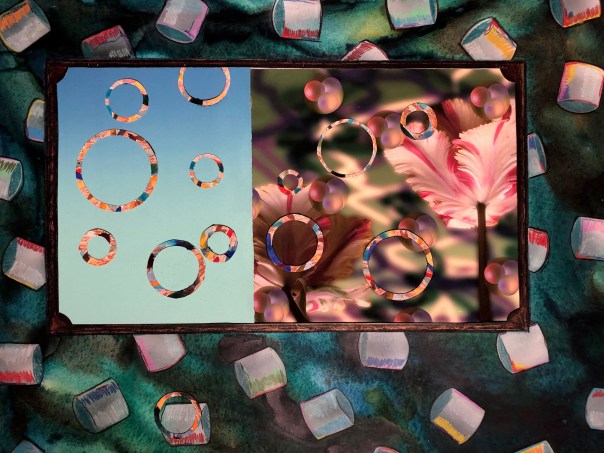
Give ’em something to look at…(FLOATATION DEVICE).
This lesson is a reminder that above all, visual art is visual. Notwithstanding all the “non-retinal” art in the world; from Maurizio Cattelan to Marcel Duchamp; who lets us know that art is a mental process. Trying to bridge the gap, let’s have a lesson, a little thing I like to call: Give ’em something to look at.
The images in this collage were made over a period of 30 years±.
In 2001 when we were starting out our digital printing biz Gary Bukonvnik was in the EW shop for a mono printing session and brought the tulips in for a still life. (Already we are telling a story, slathering itself across the brainpan.) So…tulips lying on a white paper were selected out so a background could be added.
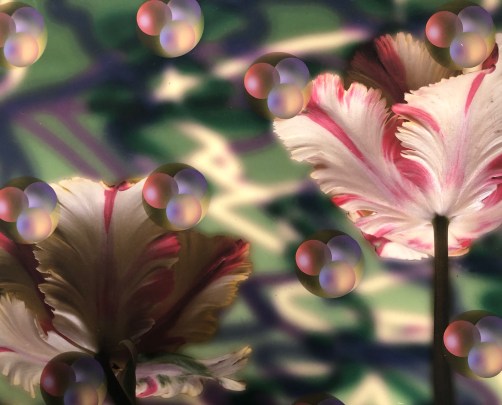
In 2005 a couple of molecules rendered in a 3D program put in amongst the petals and printed. Then smeared out in PhotoShop.
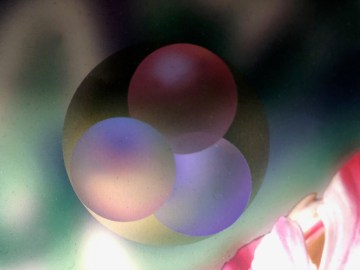
A watercolor from mid-nineties didn’t quite cut it so I cut out the circles…(they have some nice colors)
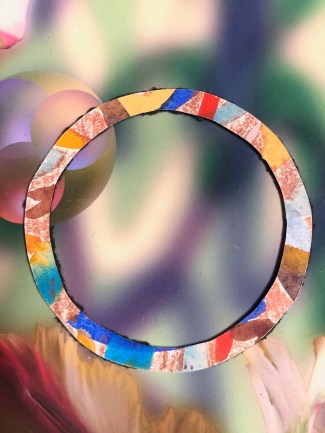
The tulip and molecule image was destined to be a Burning Man hand-out. (We handed out these prints at the event ). So there are the Tulips and the molecules. The sky-blue on the left was a monoprint from 1982.

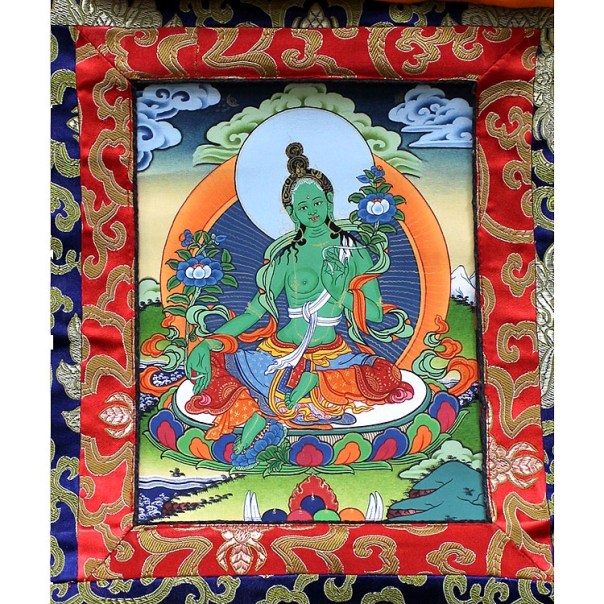
Those tumbling cylinders were from a time in 2003 when I was trying to emulate Tibetan art forms, at least the visual density of that form of art, anyway. How do you make an image appear 3D on a flat paper?
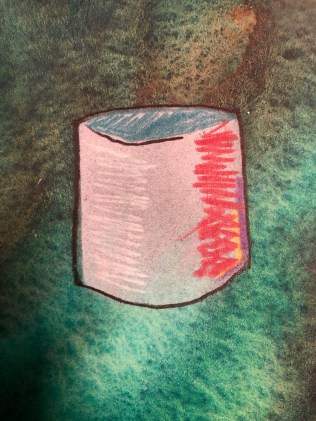
All the time I am thinking of how to say everything at once. My goal was to make a visual density like a thangka—to say it all, all at once. Image making as a spiritual exercise.
When I had it all together—tulips, rings tumbling cylinders I sat down to feel my way through what I had made. As a title Floatation Device came to me in a flash and it feels right.
So this picture is called Flotation Device. I’ve tried to put in as many modes of representation as would fit on a page and still be able to be read—Some of the many ways we use in this age to depict the world. And to keep it “afloat”. Who wants to talk about floating when you can feel it bodily with the help of a picture. The Chinese are famous for their word pictures. Here is the title in simplified Chinese:
浮选装置 or mea uila in Hawaiian
So… now we can have a dip into Walter Benjamin for “The Work of Art in the Age of Mechanical Reproduction”. That complexity of a thought is: We live at a time (for the past 100 years) when an image is no longer the rarity it once was. Including TV and film, we are soaked to the bone in pictures. Have we become numb? Numb to Seeing? Numb to meaning? In reaction we see the rise of the meta images. Pictures whose content is the idea of a picture.This picture called Floatation Device. Does it give the feeling of floating? Walter Benjamin convolutes his thoughts so densely that they become meta thoughts. Suffice it to say, the title of his essay.
So, tieing this together—A picture of a picture? The clue from the Tibetan thangka can start the ball rolling and point to our next section of exploration: In their ritual practice (we’ve all heard the monks chanting) — what is it they are saying? They are chanting a description of the picture which is what we have done in this lesson. Not only what but HOW.
Last up in this romp into thinking about thinking, seeing about seeing let’s give the magician of music, Carla Bley the last word in her piece called Lawns.
 Now of Now Art
Whoa!! This is a complex a beautiful lesson. My rev will keep me busy a long time on this one!
LikeLike