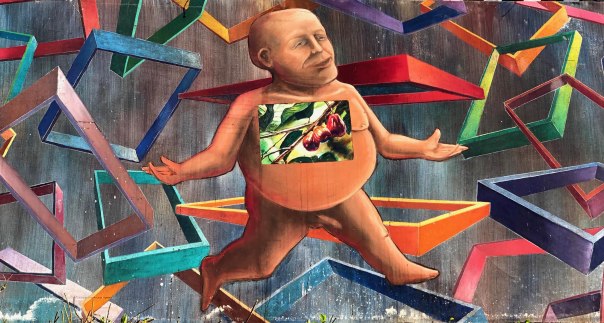
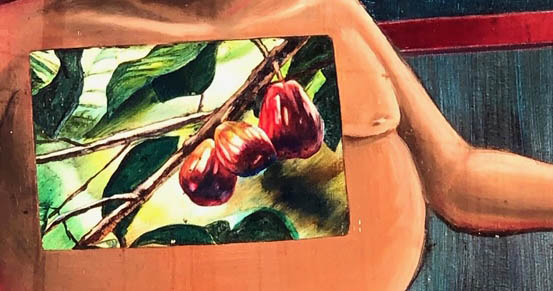
So allow me to introduce you to Señor Hamhead. He came to me on a trip to the far side of Haleakala on Maui. Tramping through the dense forest I came on a thick plantation of this fruit planted by the native first-people who brought the trees with them in their out rigger canoes—the Mountain Apple. The fruit is thin-skinned and perfumy a bit watery, but like the banana or pear only tastes like itself. Refreshing comes to mind. This plant had originated in Malaysia.
I painted this at a time of great ambition. I showed it to a dealer who suggested I enter psycho-therapy. It carries a great failure and caused me to lose my nerve for a time. Sure was fun to paint, though. The painting suffered damage from the barn-rats nesting on the stretcher bars. I was working through some “issues,” like—are you MAN enough? and How much is self-worth attached to money? Have I come to resolution? Jury’s out.
Senor Hamhead visits the Garden of Eden (Detail)
I’m showing you this not because I now “like” it. (Still don’t) It had languished in our barn until some repair work unearthed the poor thing. It does carry two ideas of interest: 1) it taught me a thing or two about the value of doing the “next thing” as a studio tactic, acting on impulse can open a pathway to the collective unconscious. and 2) taught the truth of pictures living inside of other pictures. These two ideas have formed the basis of what I like to do as an art practitioner….in this picture I’m trying to come to terms with the idea of pleasure taken from us by the Judeo/Christian false idea of morality. Garden of Eden and all that…
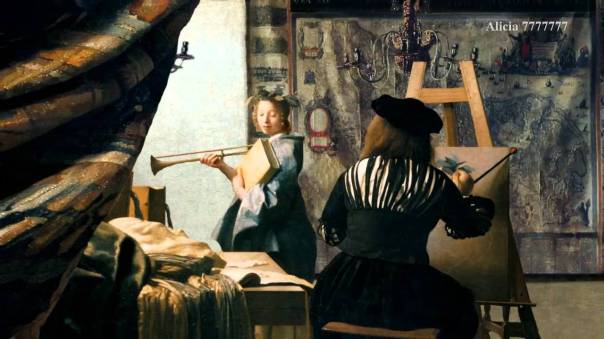
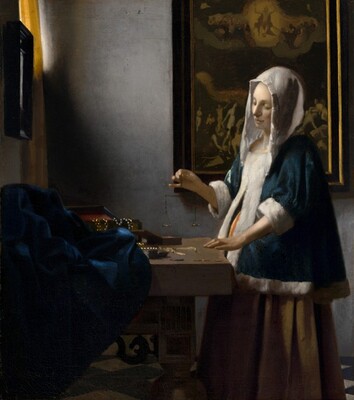
I’ve been at this picture in picture forever. This is an old idea, in fact ancient, ancient as the cave walls of stone-age Europe. And ole Uncle Vermeer was a great practitioner of PIP.
The Art of Painting
I love looking at things, things as thoughts, things as things. Things as thoughts?? That’s called philosophy, right?
Woman holding a balance
To find true things inside and out, I made this “Hamhead” picture, my mind was tumescent with longing for all things. Sure, sex-ever-present, but mostly I was looking for true things, a pleasure in the hunt as well as in the finding. Pleasure. The mind as a sex organ, and look!, that fruit is so luscious. Its dying to be eaten in a fulfillment of genetic destiny.
So much arguing on one page to find the truth.
Pages from the Talmud informed my thinking, here is text and commentary on the Law. Word pictures inside word pictures.
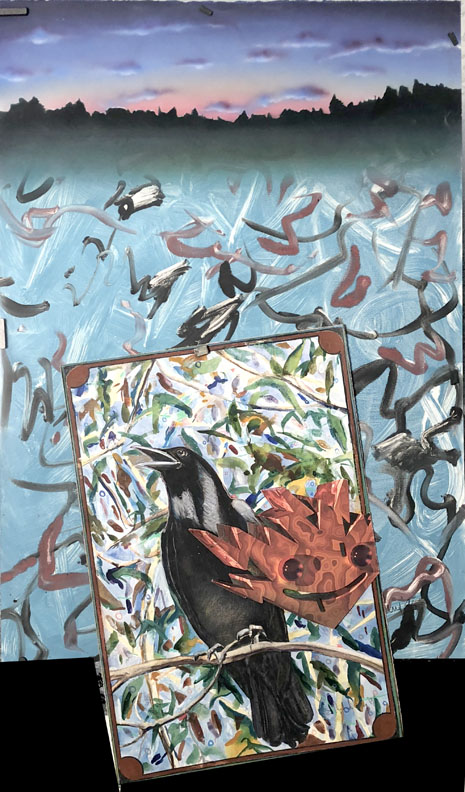
King Carlos is of Two Minds
King Carlos wants to remind us that the world is complex in it’s figure/ground relationships. We carry in us feelings, thoughts, emotions as we move through the world of visual sensation.
Beauty is No Joke
So complexity lives within us all. This little orange guy found its way as a shock to my pretense of making “great” art. He’s saying, “Just get on with it, buster, the world is more magical with a little good humor”… all the while informed by the view out my studio window.
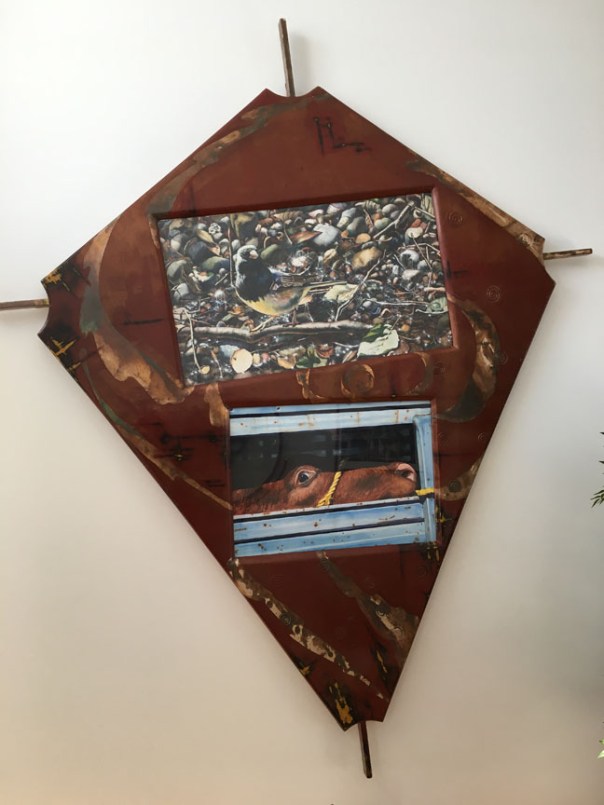
Finally, with a nod to that ambitious self, wanting to say something about the Christian matrix we find ourselves swimming in…
“We are but waves of light constrained by walls of circumstance” Watercolor pictures set in a lacquered frame 108″ X 68″
These days we need all the good humor we can muster. So David Senior’s presentation at the Logan Symposium on the Artist’s Book at the Legion of Honor was a perfect uplift, countering the unending bad news of the day. He brought to our attention an amazing mix of projects that we had never heard of. In preparation for this post, many happy hours were spent ferreting out the links :
David Horvitz discussion of his photo project “Sad Depressed People” and “Mood Disorder” has me questioning my own.
Horvitz staged a portrait of himself enacting a state of depression. When posted on Wikipedia it went viral and has been used hundreds of times to represent this sad state of being. He is tracking how an image disseminates across the Internet. After collecting the many uses he published his findings as an artist book.
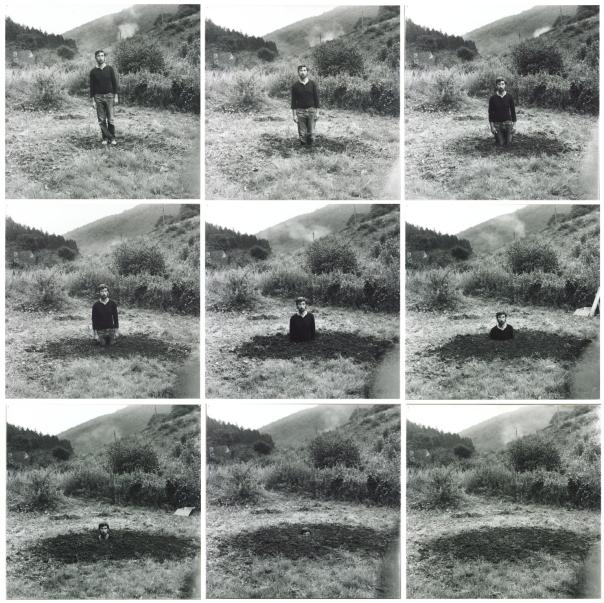
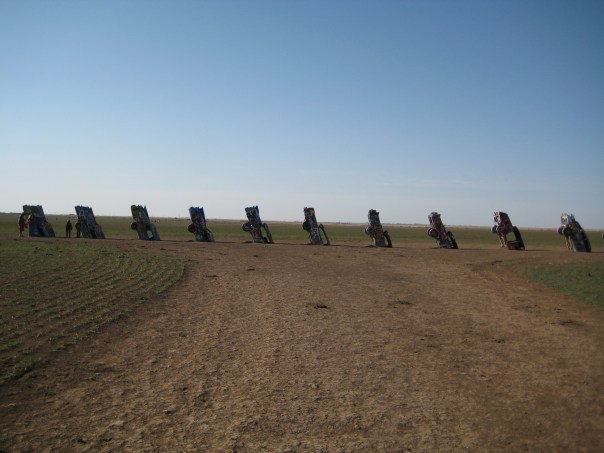
There are several other burial projects worthy of our attention. The famed Cadillac Ranch Amarillo Texas, 1974. Ten Cadillacs were buried nose first in a chronology of the development of their tail fins.
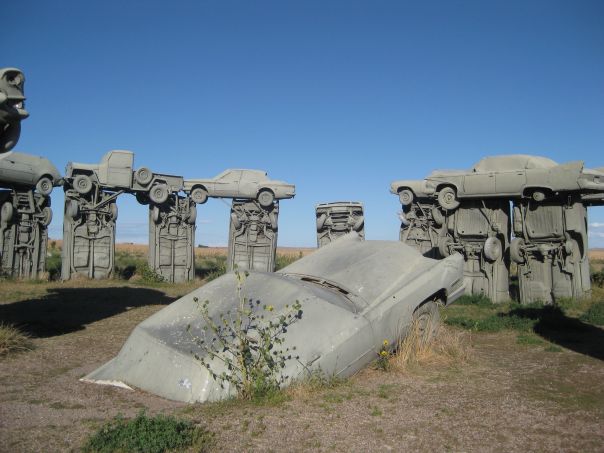
Carhendge in Alliance, Nebraska, is a replica of the monumental Stonehenge in England.
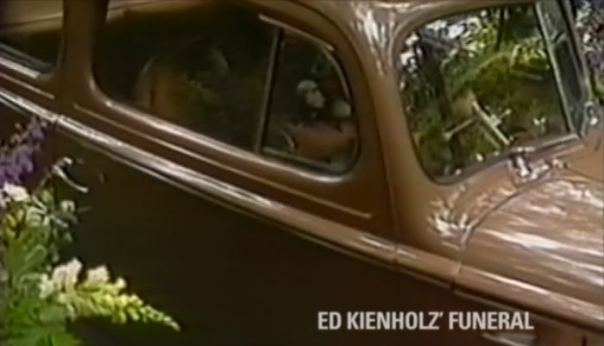
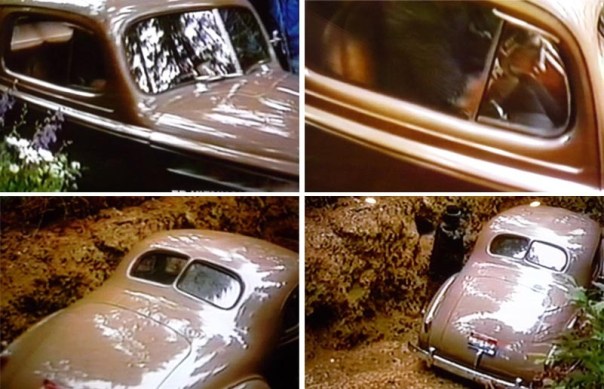
Last, but certainly not least — Edward Kienholz’s final art work in 1994 was his burial, which took place at a hunting cabin he owned on top of a mountain in Hope, Idaho. He died of a heart attack at age 65.
Robert Hughes writes: “His corpulent, embalmed body was wedged into the front seat of a brown 1940 Packard coupe. There was a dollar and a deck of cards in his pocket, a bottle of 1931 Chianti beside him, and the ashes of his dog Smash in the trunk. To the whine of bagpipes, the Packard, steered by his widow, rolled like a funeral barge into the big hole: the most Egyptian funeral ever held in the American West, a fitting [exit] for this profuse, energetic, sometimes brilliant, and sometimes hopelessly vulgar artist.”
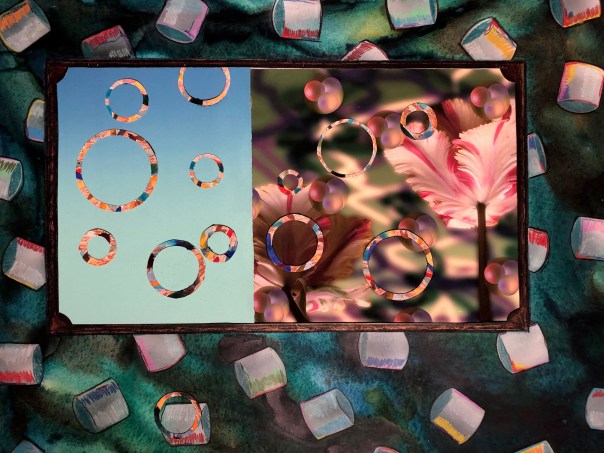
Give ’em something to look at…(FLOATATION DEVICE).
This lesson is a reminder that above all, visual art is visual. Notwithstanding all the “non-retinal” art in the world; from Maurizio Cattelan to Marcel Duchamp; who lets us know that art is a mental process. Trying to bridge the gap, let’s have a lesson, a little thing I like to call: Give ’em something to look at.
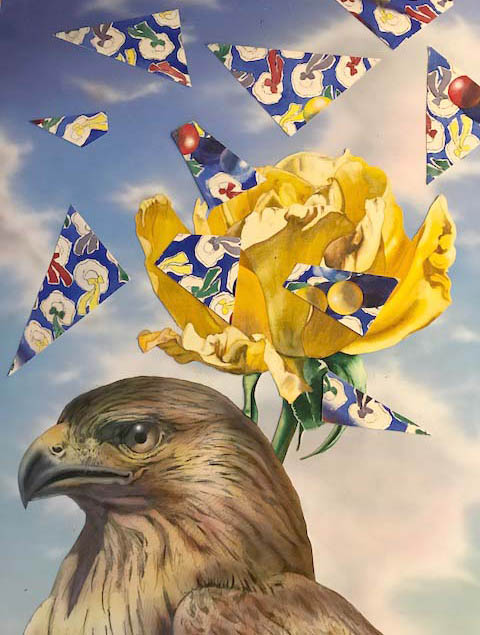
The images in this collage were made over a period of 30 years±.
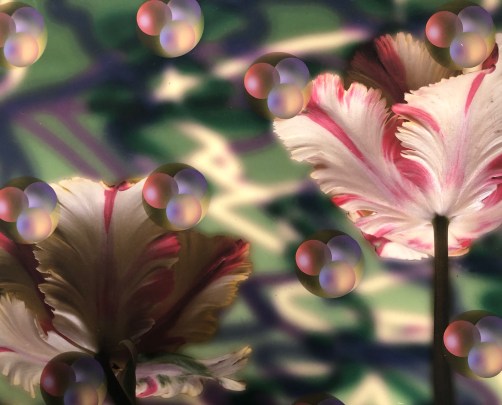
In 2001 when we were starting out our digital printing biz Gary Bukonvnik was in the EW shop for a mono printing session and brought the tulips in for a still life. (Already we are telling a story, slathering itself across the brainpan.) So…tulips lying on a white paper were selected out so a background could be added.
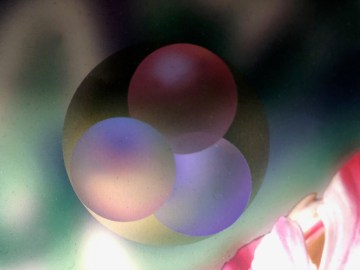
In 2005 a couple of molecules rendered in a 3D program put in amongst the petals and printed. Then smeared out in PhotoShop.
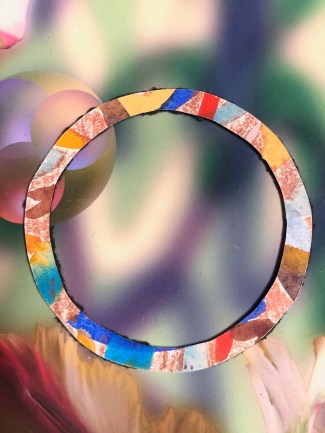
A watercolor from mid-nineties didn’t quite cut it so I cut out the circles…(they have some nice colors)
The tulip and molecule image was destined to be a Burning Man hand-out. (We handed out these prints at the event ). So there are the Tulips and the molecules. The sky-blue on the left was a monoprint from 1982.
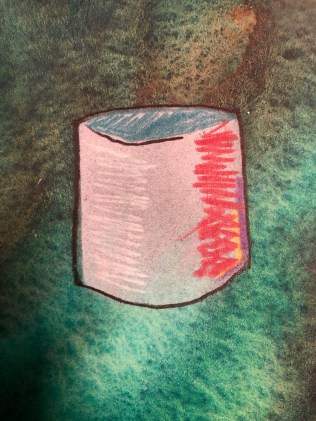
Those tumbling cylinders were from a time in 2003 when I was trying to emulate Tibetan art forms, at least the visual density of that form of art, anyway. How do you make an image appear 3D on a flat paper?
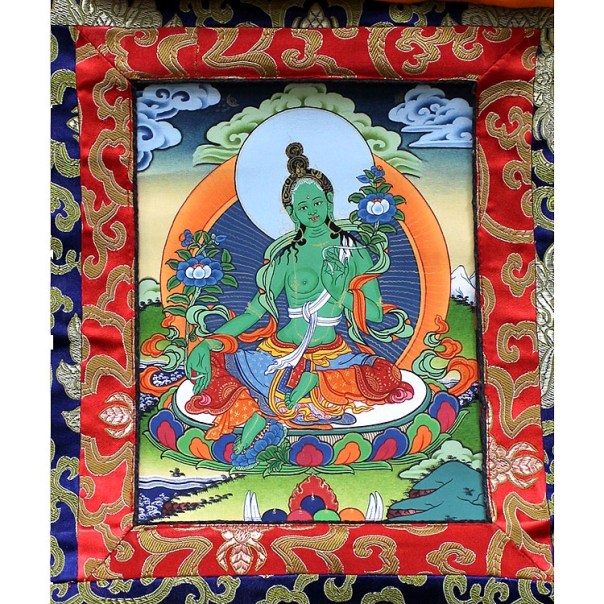
All the time I am thinking of how to say everything at once. My goal was to make a visual density like a thangka—to say it all, all at once. Image making as a spiritual exercise.
Green Tara—Compassionfor the Earth: Pictures in pictures.
When I had it all together—tulips, rings tumbling cylinders I sat down to feel my way through what I had made. As a title Floatation Device came to me in a flash and it feels right.
So this picture is called Flotation Device. I’ve tried to put in as many modes of representation as would fit on a page and still be able to be read—Some of the many ways we use in this age to depict the world. And to keep it “afloat”.Who wants to talk about floating when you can feel it bodily with the help of a picture. The Chinese are famous for their word pictures. Here is the title in simplified Chinese:
浮选装置 or mea uila in Hawaiian
So… now we can have a dip into Walter Benjamin for “The Work of Art in the Age of Mechanical Reproduction”. That complexity of a thought is: We live at a time (for the past 100 years) when an image is no longer the rarity it once was. Including TV and film, we are soaked to the bone in pictures. Have we become numb? Numb to Seeing? Numb to meaning? In reaction we see the rise of the meta images. Pictures whose content is the idea of a picture.This picture called Floatation Device. Does it give the feeling of floating? Walter Benjamin convolutes his thoughts so densely that they become meta thoughts. Suffice it to say, the title of his essay.
So, tieing this together—A picture of a picture? The clue from the Tibetan thangka can start the ball rolling and point to our next section of exploration: In their ritual practice (we’ve all heard the monks chanting) — what is it they are saying? They are chanting a description of the picture which is what we have done in this lesson. Not only what but HOW.
Last up in this romp into thinking about thinking, seeing about seeing let’s give the magician of music, Carla Bley the last word in her piece called Lawns.
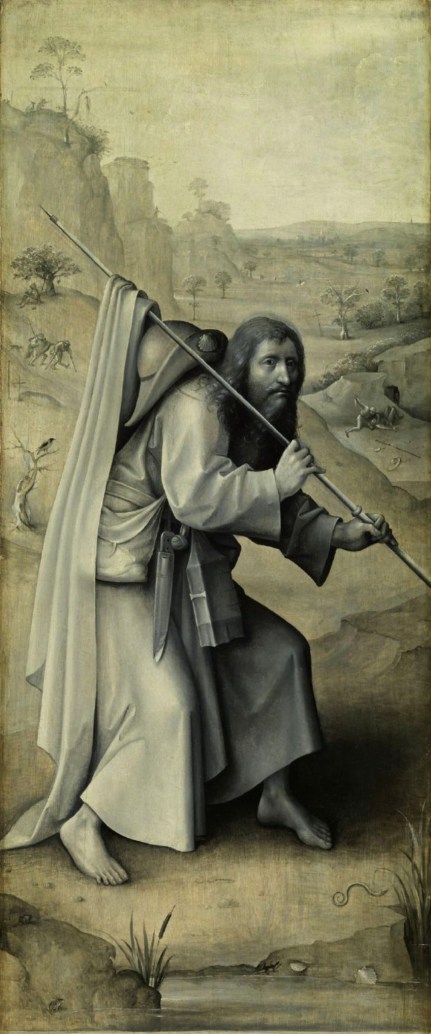
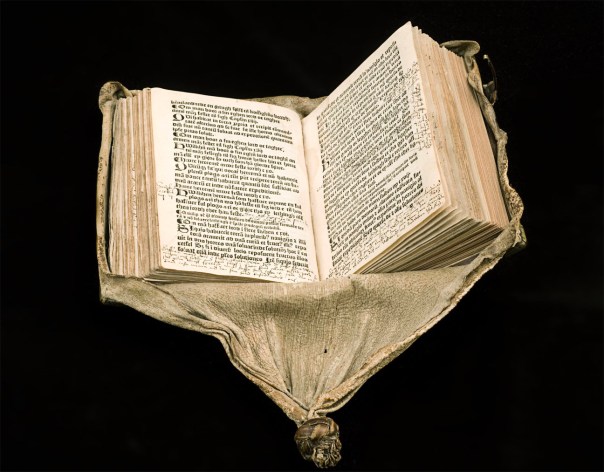
Saint James wearing a girdle book in 16th C panel by Hieronymous Bosch
Just the mere mention of a girdle makes me squirm. Makes me shudder at the thought of what I used to do to squeeze myself (no, wrestle my hips and thighs) into what was considered to be an ideal body configuration.
So when Susan Tallman, keynote speaker for the Logan Symposium on the Artist’s Book at the Legion of Honor mentioned, “Girdle Books” the only thing that came to my mind was Playtex.
In the late Middle Ages a type of portable book evolved that we call a “girdle book,” describing how it was carried tucked into a girdle or belt. With the founding of religious orders like the Franciscans, and with the increasing interest in pilgrimages, there came a need for portable books of personal devotion such as breviaries and prayerbooks. A kind of 14th C. ask Siri pocket book compendium, a go-to place for ready reference.
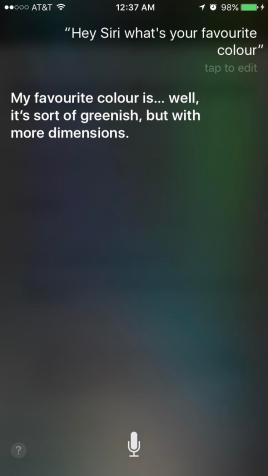
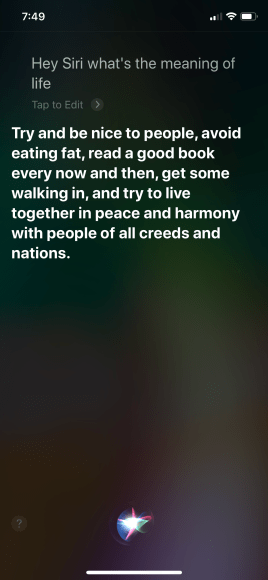
These days, I propose a new kind of fashionable accoutremont: call it Siri Sack and tuck it into your girdle or belt. Or do like I do, wear a hippie-style crochet bag purse slung over the shoulder. My bag is the perfect size for sleek iPhone and is always handi. Yes, “handi” as in “have you seen my Handi?”—that’s what they call a cell phone in Germany.
Along with asking Siri fact-based questions about the weather or the price of corn futures on the commodity market, a question relevant to our study of color can add dimension, a philosphical question can evoke at timely answer or how about a joke?
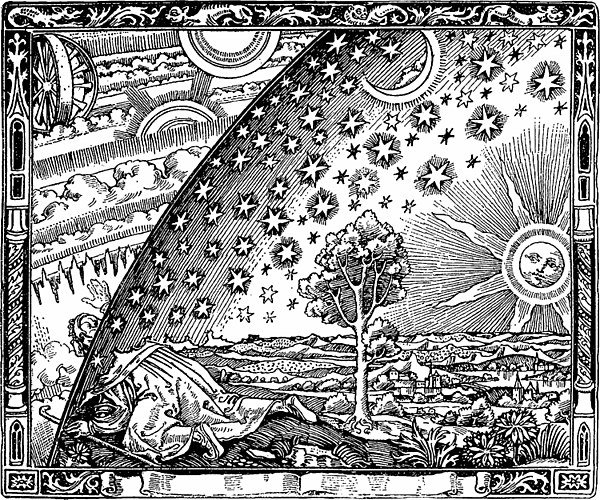
Camille Flammarion was the French astronomer who was a great popularizer of the study of the heavens. He used this wood engraving by an unknown 18th Century artist in his many books, often described as a seeker of wisdom, peering into the mechanism of the universe.
Something like a great force of gravity happens when you decide what your life’s work will be, and if you decide on a career as a miner in the ‘made-up” world of art, that gravity can densify and go to super nova. And, if you do it for a long time, something fixed, a permanent piece of furniture in the mind’s mansion, holds its ground. How is this different from the mind of “make a market” of the business world? A world of derivatives, of puts and calls, of financial instruments….business is as abstract as art making and yet fortunes rise and fall like the very real cities funded by the make-a-market world of finance. It is a different species of human interest but still in the same family of focused energy and we’ll get to it in a bit. Science is another territory in the magical world of thought brought into the world of “stuff”. We’ll visit that country of proofs and curiosity mingled with the certainty of maths and science. The .gov, .edu, as well as .com have mapped these domains of human interest but to to get us started, to lift the skirts of my magical world of art, we go to senior English class in a boy’s boarding school at a time when the Vietnam War seeped its malevolence into every crevasse of the culture. A time when the original sin of America (slavery) was showing signs of receiving absolution in MLK’s dream and Cassius Clay’s (not yet Muhammad Ali) impertinent righteousness. 1965. The counter-culture was a vague perfume wafting in from California, in on the heels of Beatnik, not yet codified by LIFE Magazine.. “Are you in the movement?” I’d be asked a year and a half later at GWU. Freaking out on my first sampling of strong weed soothed back to some kind of calm center by Otis Redding’s Try a Little Tenderness on WOL (the station that brought the nitty gritty to the Capitol City), that same week a sock in the jaw at a peace march loosing a tooth, I’d have to answer the question, “Are you in the movement?” with “I guess so.” Volunteering as a tutor at DC jail would fill out my “movement” credentials. Just 18 months had passed from “Ruling Class High” boarding school to dope smoking long-hair “relevance” so swiftly had that train of culture gained momentum .
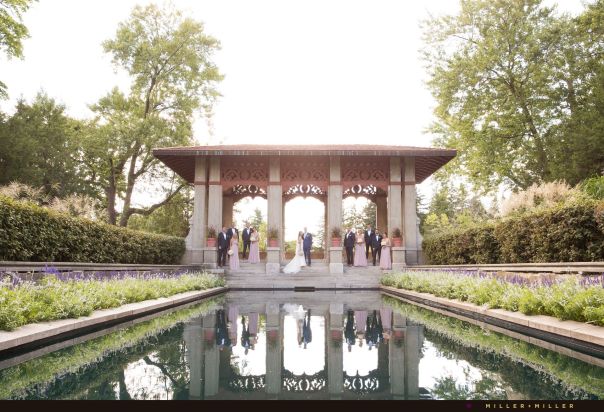
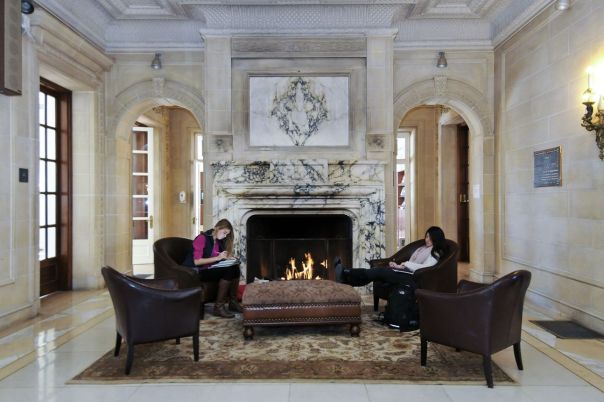
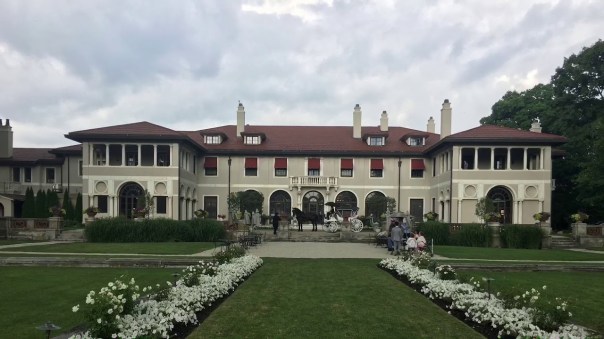
Lake Forest Academy (LFA) boarding school was located on a “Robber Baron’s” estate approached down a mile-long oak lined driveway. The Armor Estate, Mr. Armor gained his fortune in Chicago’s famed stockyards supplying beef to feed the Spanish War and then WWI. We went to classes in the bedrooms of the estate and ate our meals in a marble-walled ballroom with a carved marble fireplace, backed with a dribbling fountain at one end. We studied in a wood paneled dream of a library with birds and fruit worked out in black walnut by old-world craftsmen. We wandered in a clipped formal garden ending with a pergola of Italianate design.
You want to “out-fancy” your friends? Have your wedding under the Pergola at LFA
The Robber Barons fled Chicago after the Haymarket Labor Riots of 1887, incorporating the town of Lake Forest as the largest “village” in the US by gifting a large piece of land to the government to create Fort Sheridan as a buffer between the seething anger of oppressed labor and the ruling classes.
Study hall at Ruling Class High
Or family had money enough, never lacking, but to be in such opulence even at 100 miles from home made me cringe; classmates were the sons of industrial captains, bank presidents, etc. The grandson of Igor Strvinsky was a cohort. How did I get to this place? So far from the small-town life of Kankakee, Il? A familiar story of “taxpayer revolt” The short-sighted folks of Kankakee County thought they could get awway with not funding schools. Foreign languages were cut. Art classes? Who needs it to work at the Roper Stove plant? The high school went to tripple shifts. About 20 of us were sent “away.” We’d see the same thing a decade later in the state-wide debacle of Prop 13. California went from #1 nationally to #49 competing with Mississippi for the bottom in funding for education.
My first longings to do and be something “authentic” took root in those days. The paradox of feeling weak in the face of wealth-being-unearned, coming from a blue-collar farm & factory town 100 miles to the south. “Little Richie Rich”gave birth to the feeling—that to feel you deserved your good fortune—you were owed such abundance—you must be some kind of sociopath. The nascent world of do-it-yourself-liberation formed the core of what would become cool in me and in the coming counter-culture.
Do you feel important or diminished by such opulence?
So this is the moment: Kennedy is dead, Johnson is getting his social agenda through Congress by giving the perfidious yahoos a jihad against the Commies, troop levels in Vietnam at 350,000 and rising, skirts are inching up and nipples are sprouting like spring crocus. Truth be told, this fills 98% of my head space—sex and war, but there was a space that opened up for art and it happened in English class in this boy’s school.
We were doing American lit, Poe in the docket. What do we mean by the “Sublime” in literature? Finding what lies under the rocks, the gooiest darkness, The Pit and the Pendulum, and the rest of Poe’s box of terrors. There we would find ample sustenance to feed the sublime, that undiscovered country where terror would change the heart of a story. Make you pay attention. Where is the contemporary version of the sublime? The thing you could almost understand, but not really. We were given Susan Sontag’s Notes on Camp published just a year before where Andy Warhol figured to be the new American Poe. The horror of consumer culture. No, not with terror but with Camp. Wow, this was hard. Camp was a Brillo box posing as art. I mean “Art”. For like Poe, Andy was all pretend, so far out there, it was thought crawling with pretend seriousness, the bugs under a rock scurrying to hide like difficult thoughts. Did I understand? Only one thing.
I understood that the pretend world of Poe was somehow linked to the pretend world of art, to theatricality and in the Sontag piece this theatricality was linked to the Homosexual World of High Fashion and the giddy placement of quotes around anything. A breadbox becomes “a breadbox”, a car becomes a “Car”. I knew this world, introduced to my family by an interior design couple, Bob and Ralph. Not yet signified as gay, they were truly gay. Of course they were homosexual, but I learned what high-minded fun was. Dinner parties at our house were very much fun; high times. My parents were (though small-town, were hardly rubes) “beautiful people” in the making. So, the Sontag piece set my mind a flame. I understood and had witnessed something first-hand that was at first blush hard to understand but became a pole-star in my personal firmament.
That year would prove to be a watershed year. On a field trip to the Art Institute to see the Giacometti retrospective I was slammed by and carried away by the seriousness of high art which opened me to ineffable tragedy of human existence. Giacometti was the über existentialist saying to me “life is a grim singularity” just get on with it. Sontag by way of “notes”, opened me to the campy world of Pop art. Life was gay and light-hearted floating by on fairy wings, lifted impossibly by abject terror. The two worlds of High art and low-down Camp became poles on a continuum containing the mystery of the creative life.
I graduated that June of ’66 and just days after found myself bound for Germany for a three-month family stay looking beyond the dome of my little life, and diving into the heart of the beast. It would become a moment of terror, a play called A Jew Visits Der Vaterland. All this high-minded thinking would vanish like “snow on the water” as the world changed in an instant with the 60’s full throttle roaring away, but I often came back to the “sublime” the effort to find my place on the continuum.
Trees were recently big news, a trillion of them, at the Davos Economic Forum when Greta Thunberg lambasted Trump’s plan to just plant more trees to stave off the effects of global warming. As they swung at each other, their comments swung between outrage and optimism.
Ms. Thunberg: “We are not telling you to offset your emissions by just paying someone else to plant trees in places like Africa, while at the same time forests like the Amazon are being slaughtered at an infinitely higher rate. Planting trees is good of course, but it’s nowhere near enough of what is needed, and it cannot replace real mitigation or rewilding nature.”
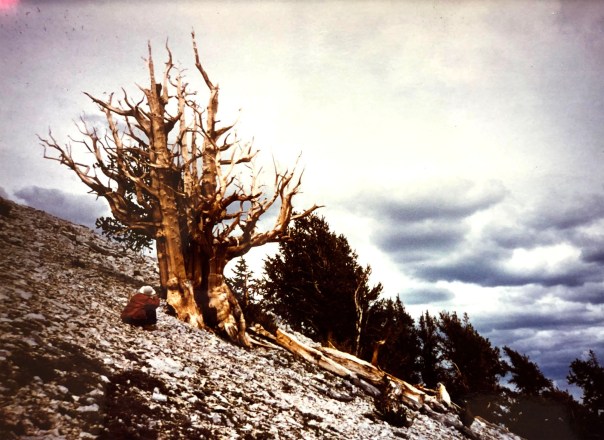
Bristlecone pines are famous for attaining a great age. Once the seedling has established itself, it grows slowly, oh so slowly, making the bark tough and resistant to rot, insects, and fungi. The oldest, Methuselah, clocks in at 4,817 years. The trees are dated using a coring device to bore in and extract a very thin sample. Then the rungs are counted to determine the years and to study the markers of extreme weather conditions. Now these trees are serving as enviromental time keepers, as chroniclers of weather and geologic events, confirming evidence of climate change.
Empires rise and empires fall and the foibles of humanity go on and on. These trees have survived catastrophes and they hopefully will survive our latest environmental folly.
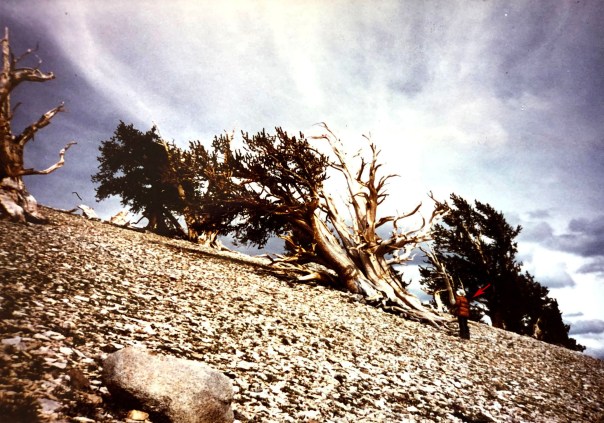
For thousands of years, in the rarefied heights (10,000′) they have endured, standing strong — reaching to the awesome clarity of space and griping tenaciously to barren rocks in a testament to perseverance. Shaped by wind and snow, hardened and polished by the forces of nature, the bristlecone pines twist and dance over time with tenacity.
In 1980 I made the arduous trek to the Ancient Bristlecone Pine Forest in the White Mountains. Since then these awesome life forms have loomed large in my imagination. With sketchbook in hand I am the tiny figure with the orange parka and the white hat, (red arrow pointing).
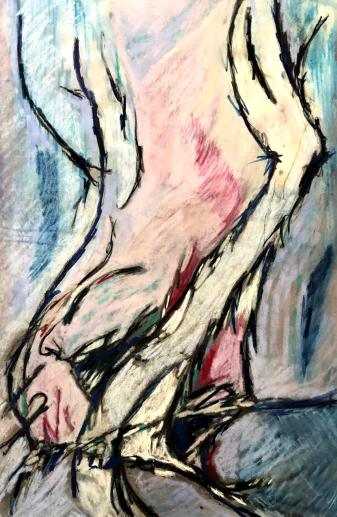
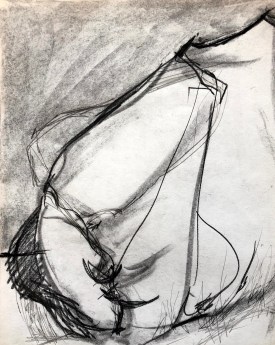
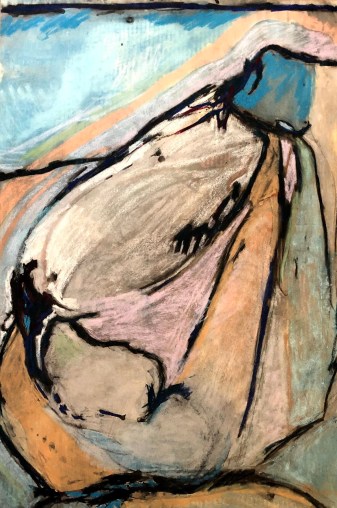
Back in my studio, from my quick plein-air 9″ x 12″ charcoal sketches, with pastel and pencil I enlarged my drawings to 24″ x 35″. Perhaps it’s my bent towards anthropomorphising their astute qualities but especially now, looking back some 40 years, I see the human figure in my forms.
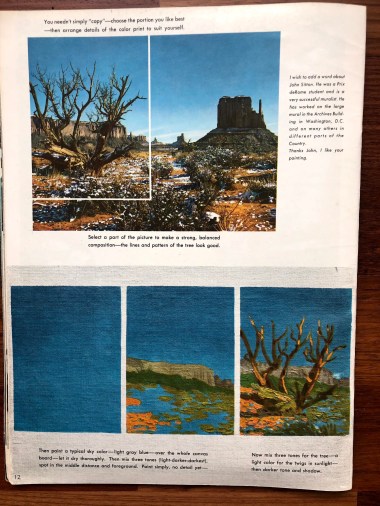
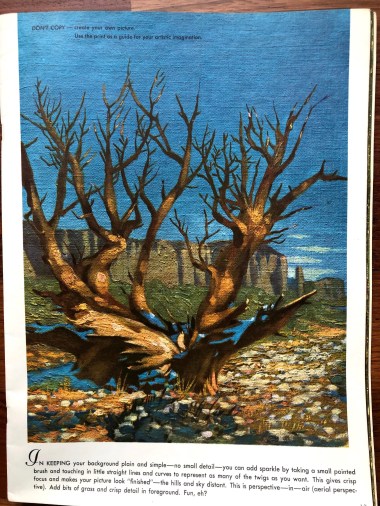
In my teens, trees were a subject. Both of my parents learned the basics of painting from the Walter Foster How-To books. His step-by-step instruction made it easy even for beginners to accomplish a detailed landscape. His lesson on the gnarly branches of the juniper tree in Monument Valley was the source for the painting that hung for years in our family den. Revisiting this now, I can see how my expressive marks, took a cue from WF.
Any discussion of trees must include W.S. Merwin — his poetry and his commitment to planting trees. The Poet Who Planted Trees .
For tenacity, we’ve now been at it as artists for a long long time. For trees, we don’t need trillions, just one or two inspiring examples.
As we draw and paint, a conversation ensues. Our marks on paper, on canvas are our responses to the voices, the tastes, and the touches we experience. By making marks, we create ourselves a tiny bit more – and we can actually see more and feel more, because we have, in that tiny bit, become more.
We all live inside the theater of our minds. The skull, the forehead as the proscenium. Dreams, daydreams, thinking stuff up, inventing the day as you drive to work. Theatre people talk of the “fourth wall” the curtain opening and closing as we move from private thoughts in darkness, then into the light of the world seen around us. This story is about all that mind in motion, inside out side. Inside, what was I thinking about when I went to see the Juan Gris exhibit at the Berkeley Art Museum in 1987. What was the internal movie playing on my proscenium?
I was fixin’ to leave a marriage, a marriage we had “worked” on in carpeted quiet rooms to no avail. We just rubbed each other the wrong way until our fur was sticking up all pointy-like. There were two endearing and ripening children. And a third who’d been bashed by another divorce, but not down for the count, ready to launch into college. The younger ones needed both a husband and a wife to care for them. What to do? “Don’t worry, kids, your father will always watch over you.” That was the stuffy room we were living in, with no answers on the horizon. Somebody open a window would’ya? In this state, the internal sound track playing was Lester Young playing two to tango. Is the repeated line really “drop yo drawers, drop yo drawers”? It is. Two to tango indeed. Probably how we got into this stuffy room in the first place.
With all the cacophony of a troubled marriage, kids, and pretty much, very recently, solidly reaffirmed in my dedication to the artist’s mind, I had a lot going on…My teaching job had vanished like snow on the water into the caldron of the witch’s brew of Prop. 13. (45 years later it’s finally being remediated—it’s the tax-cut proposition that rocked CA schools out of #1 position in excellence in the US to #47) and I was hard at it editioning lithos of my watercolors to remake my money life. Things were compressed and very rich and not at all comfortable. These days, I know what comfortable is, thank god. And that sense of being comfortable goes back to the feeling of the Open Window.
I walked into the Berkeley Art Museum to see the Juan Gris retrospective. First off, and you have to believe it, the museum itself was a Cubist wonderland. Empty now, and shuttered for seismic peril resulting from the Loma Prieta Quake of 1989…it was great place to see most kinds of art. Big wide vistas across an internal court and little nooks where you could be surprised. Time and Space explicated in Brutalist Concrete, walls left to be as close as possible to the plywood that shaped their molding in concrete….. You were on a shelf looking out into It. “It” being the bustle of the world. It’s your own body out there in space looking at pictures on the wall as if from some forbidden fastness. Somehow you’ve gained entry into a kind of precious temple of cubism with many hidden secrets, one after another, just around the corner.
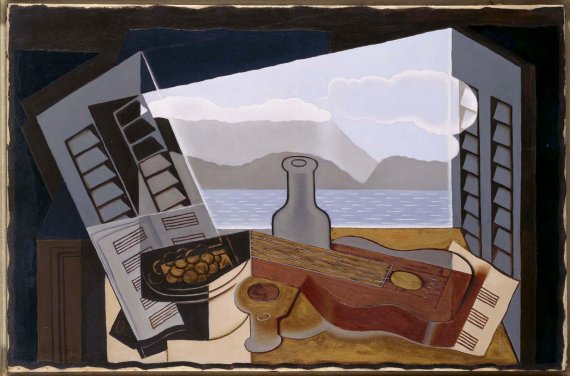
The Open Window Juan Gris 1921
You follow the curator’s direction and visit a logical progression of the Gris’s development—these days the kind of stuff you find on WIKI. Then suddenly it’s in front of you shining with its own light. Not so much the illusion of light but the light of compositional precision. It glows with “rightness.” It steps directly in front of all the other pictures, in front of all the other pictures. The shutters become your very rib cage as uplift drowns all the rest of your internal landscape. Life is not only possible, it’s gonna be OK. It’s so perfect in telling the story of inside and outside, and there you are vibrating with all the troubles of modern life. THIS is the open heart.
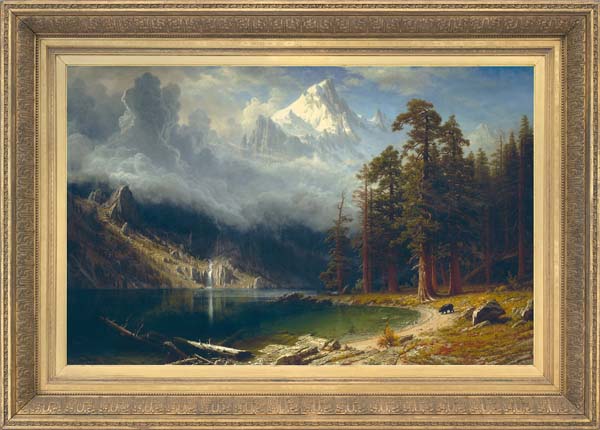
Suddenly, in a wink, my insides are up on a wall of unfinished concrete. You’ve felt this with other paintings and sculpture like the Bierstadt painting of Mt. Corcoran a feature of the Corcoran Gallery where I went to school. But the Mt. Corcoran picture is all about the outside. It doesn’t let you in. It wanted to, but somehow it’s just another artifact. Maybe it’ll open up an internal space again for me someday, but the Juan Gris is all about the movement from inside to outside and that’s important. The picture doesn’t stand as imposing, standing between you and its imposition into where you are standing. The Juan Gris picture tells you the eternal truth that — if a work of art is true, it’s a mirror.
Through the Open Window, a calm horizon is even-steven with the clouds and mountains, the regularity of the waves on a mountain lake on a breezy day, the base line. This is wisdom without all the sentimental clap-trap running through the “New-Age Therapy Culture.” It is wise and not glib. The picture is musical; the music is another of this in/out movement. Music is pictured in the guitar and sheet music tablature but the real music is the dance and rhythm of the shapes, the clouds catching a ride back into the room, surfing in on the shutters. The bottle acts as the conductor in this chamber music number.
I haven’t gained the grace of an exemplary teacher. Getting into the dark edges of things. Into the deeper spaces you find a quiet resting place.
As we pass on through to the new year (20/20) and a new decade (the roaring 20’s) we are reminded of age-old doomsday projections and apocalyptic prophesies. During my years on this planet, I have lived through my share of great dangers:
1969 The Last Days
In winter, every Saturday at 5 AM a bus left the parking lot of my Sacramento high school school filled with rambunctious teenagers primed for a day trip to the Sierras for downhill skiing adventures on the powdery slopes at Sugar Bowl, Squaw or Heavenly Valley.
In the fall of 1967, cable was strung for two new chair lifts to bridge the slopes of California and Nevada then in 1968, Boulder and Dipper chairs started running, turning Heavenly Valley into America’s largest ski paradise.
Although there was always an anticipation of the “big one” The Last Days of the Late, Great State of California published in 1968, stoked the fear. In Curt Gentry’s novel the state suffers a Richter 9 magnitude earthquake and the populous coastal regions west of the San Andreas Fault sink into the Pacific Ocean.
Psychic Edgar Cayce tied prophecies of earthquakes and volcanic blasts to the Bible, “These changes in the Earth will come to pass, for the ‘time and times and half times’ are at an end, and there begin the periods of readjustments.” Cayce saw that these “birth pains” as higher consciousness and soul growth and that life on Earth would ultimately prevail. AMEN!!!
Whipped up by predictions of imminent seismic catastrophe, on the day forecast as THE day, with a group of hearty friends, I took the ski lift to the top of Heavenly mountain so that we could, at the appointed hour, witness the shake then slide of California into the sea. We would take our stand on the edge then jump back just across the state line into Nevada and be saved from destruction.
High on the mountain top, huddled together against the blistering wind, we waited, waited for the groan and quake. 3:15…3:20… 3:30… The time was ticking by. No show. By dusk we realized we better head back or we might not ever find our way back down the mountain and that would be the real catastrophe.
1987 Harmonic Convergence
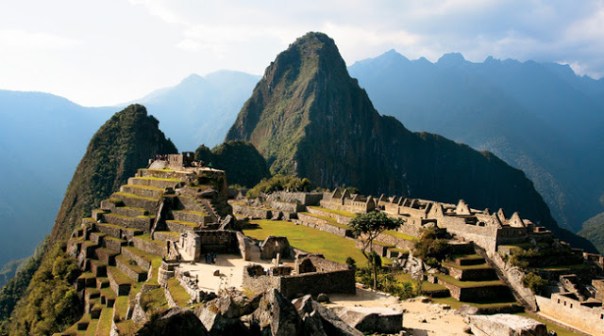
On August 24, 1987 it was by happenstance that I had just completed hiking the Inca Trail arriving at Machu Picchu the morning of the Harmonic Convergence. The trip was not timed in hopes of joining with the HC believers. On the contrary, the night before we had camped at the Sun Gate (Inti Punku) so that we could descend into the sanctuary arriving at the sacred sun stone before the tourist buses arrived. Expecting a crowd of other intrepid HC hikers congregating to witness the great shift in the earths’ energy, helping to facilitate the coming New Age of world peace, to our amazement at sunrise there was nobody there. Nobody! So we celebrated our good fortune, rambling the grounds without hordes of eager tourists with cameras shutters clicking or the humming, chanting, drone of dancing and hugging convergers. The earth didn’t make a monumental shift that day, but I certainly did. It might have been the altitude or maybe it was just the thrill (and exhaustion) at having arrived after the arduous terrain of the trail, either way I felt harmonically realigned, resonantly attuned and converged.
1999 Y2K
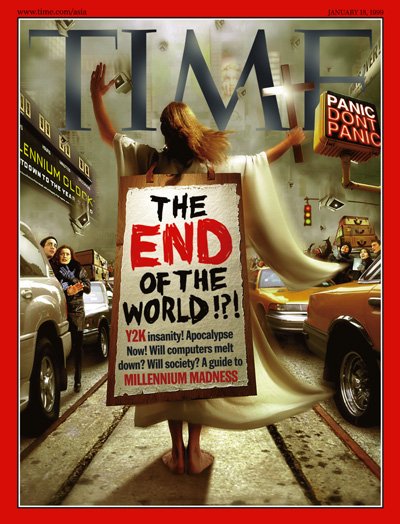
Y2K IS shorthand term for “the year 2000” commonly used to refer to a widespread computer programming shortcut that was expected to cause extensive havoc as the year changed from 1999 to 2000. Instead of allowing four digits for the year, many computer programs only allowed two digits (e.g., 99 instead of 1999). At midnight of 1999 we watched our computers screens waiting for catastrophe. 12:15…12:20… 12:30… The time was ticking by. No show. Our fears were for naught so we sent celebratory e-mails dated January 1, 2000 announcing: we made it through!!!
2012 Super Bato Saves the World
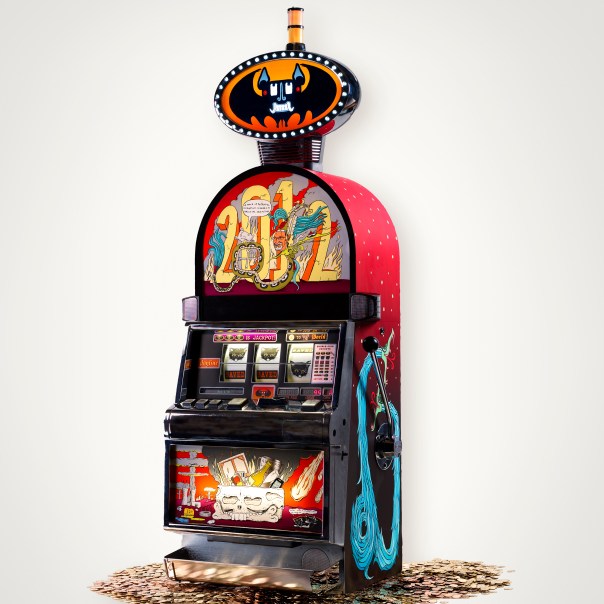
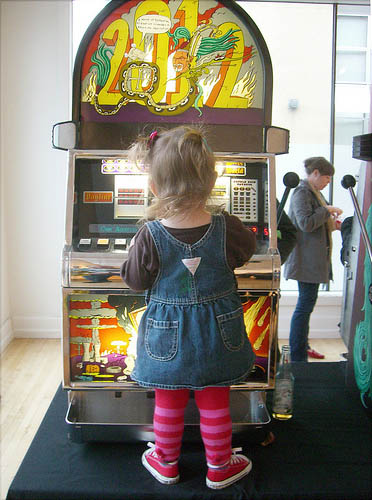
In 2012 Electric Works with Enrique Chagoya published Super-Bato Saves the World an edition of slot machines featuring talking skulls, cataclysmic fireballs and even the likeness of Chagoya with a serpentine body. Replete with graphics that spoke about discontent, environmental catastrophe and the end of the world. To appease the State Gaming Regulators, Chagoya even designed coins for use in the machines with “2012” stamped on them along with the motto: “Life is a dream, then you wake up.”
December 21, 2012 was regarded as the end-year of a 5,125-year-long cycle in the Mayan Calendar. Various astronomical alignments and numerological formulae were proposed for this date and New-Agers held that it would be the start of a period during which Earth and its inhabitants would undergo a physical and spiritual transformation which would incur both destruction and new growth. As part of the fun, we said, “if the super jackpot is won, the world would be saved.”
At the opening reception, we knew we were saved when a little girl pulled the lever and won the jackpot. NO fire and brimstone destruction, no Armageddon, lots of bells and whistles went off and a shower of coinage. Super Bato had saved the world—just look around. It was going to be a glorious kingdom come.
Crisis averted!
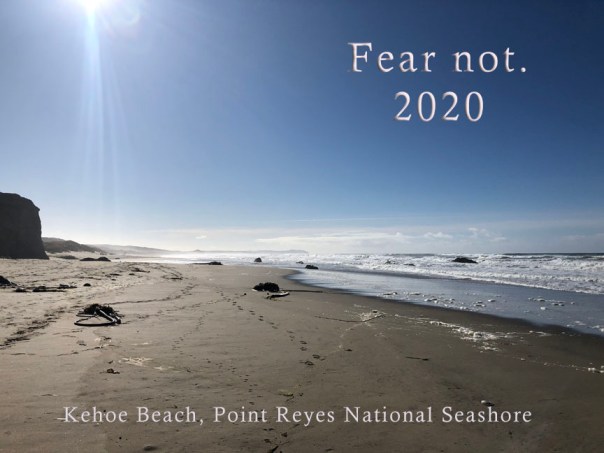
20/20 and Onward:
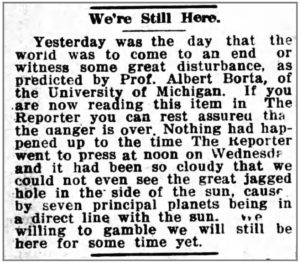
12//19/19 headline from The Leon Journal Reporter, Iowa
There are long lists of failed projections; of bad things that did not materialize. Some of the highlights include Professor Portia’s Predictions:
These days fear-mongering continues to be the weapon of choice.It can immobilize and can strike us into submission. Do not heed the politicians and the pundits call.
The descent into darkness has passed once again and the light is coming back like it has done over and over again, for 4.5 billion of years. The planet continues spinning on its merry way.
Just find your spot and get on with it — doing the important work that you were put here for — to love one another and do unto others and to the planet as you would do to yourself.
By the time I graduated college, on my way to grad school to study sculpture, it seemed all the vicissitudes had all vicissitated and we had arrived at the end of history. The Post-Modern condition; it was the new-born waiting to be fed, and for most people, art talk was esoteric mumbo-jumbo. When you lived into it as a practitioner or as an interested party, there existed no reality save the latest thought form, there was no developmental reality, no destination in this new way of thinking about art. Art meant nothing outside of its own context. We had entered the pointless forest. All meaning was provisional. There was no such thing as ultimate meaning, no potential for transfiguration. To make art that had a spiritual dimension was kind of “Crunchy”—for hippies and Pre-Raphael-ite wanna-be’s. The idea of originality in the face of “the age of mechanical reproduction” needed a good scolding behind the woodshed. Some very smart-sounding artists were hard at work appropriating, conceptualizing, and as I like to say, shaving the log of meaning down to a toothpick. I bought into it in a very big way and this thinking continues to hover around.
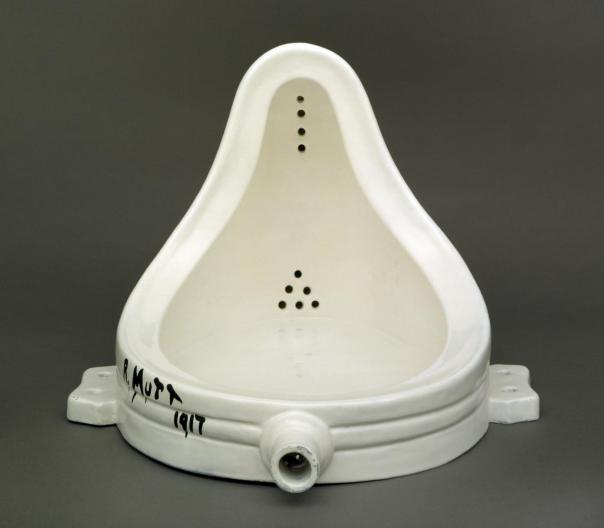
Why is Duchamp’s (Elsa’s) Fountain cited as the most important work of 20th Century art? This from a consortium of 500 critics, dealers, historians who agreed when asked in 2005 “What is the mostest bestus work of art of the 20th Century? The ready-made urinal filled the bill for importance. Topping Picasso. So what, you say? So what, I say, I when I stop trying to act smart and get on with my true study searching for the binding energy of the Universe of Art—the closest thing to some kind of Higgs Boson particle of art. I mean, art is such a powerful aspect of what it means to be human and has been since the dawn of human kind, why wouldn’t you go looking for a magic well, the wellspring, the source?
What we’re talking about here is the dynamic flow of history—the sense that a particular age could be felt through the works of art produced in that time constraint. I’m of the opinion that making art “at the end of art” was an intellectual puzzle/game and a lot of fun to play and the art the game generated dragged you across a territory you may have ignored. This is why we love art, and BTW esoteric art that doesn’t make sense at first. But once you do lean into a new style, a new movement you can find yourself in a new world. Humans like this, even if resistant at first. I do! I do! I do!. Give me a puzzle and I’m happy. But don’t you want to talk to everyone and not a just bunch of hare-brained eggheads of art?? Again, I do! —Hence I’ve been looking for a universal language, ’cause I believe art is our birthright.
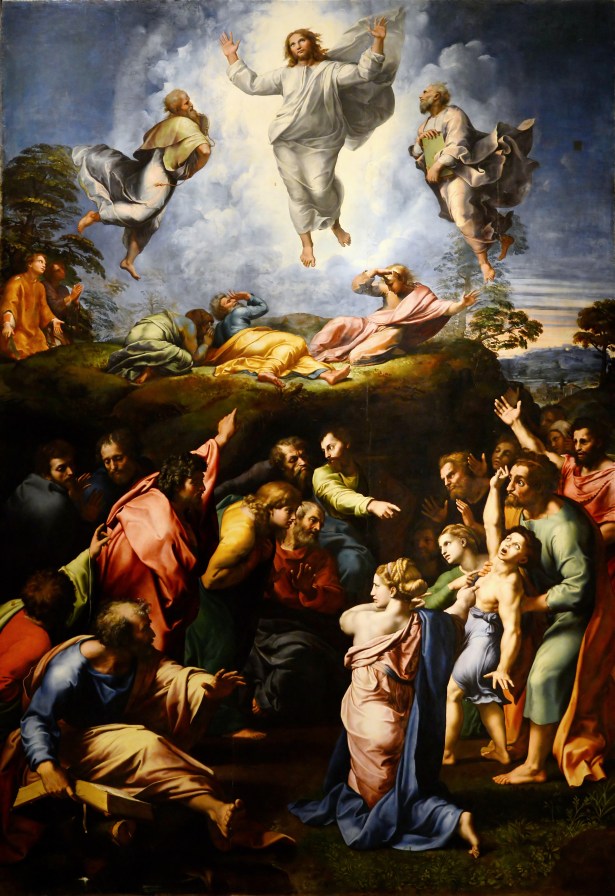
Transfiguration by Raphael — Fairy Tales Can Come True, It can happen to you…Is art a fairy tale?
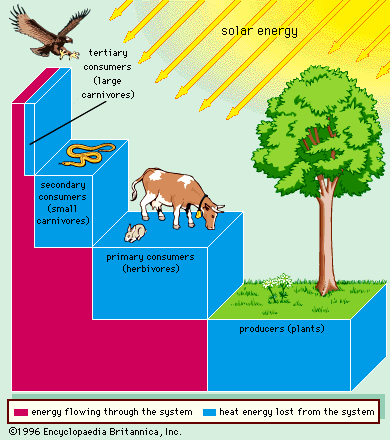
It comes down to an understanding that metabolism and energy-flow in human biological systems is altered when you engage with art especially if you believe as I do, (and everyone does really, if you come down to it) that making art is deep in our genome.
Energy flows through an ecosystem.
So think of art as the switching yard for human energy. Like inhabiting someone not you on a stage, or believing those glowing phosphors as truth on the nightly news, reaching down into your insides to pull out some music, or maybe just saying “Hey! Buddy, look at this.” … For example, seeing a close-in shot of an actor acting out the making of a fastidiously manufactured PB&J, crusts cut-off, on the popular series Breaking Bad, and you know a whole lot about the guy. This is the infill the mind does. This is how the pictures we make for each other, become revered, revered when they reach into the well, the source of the water we all share as part of our genome. Images and sounds and words and pictures or just a compelling presence as for example the sculpture of Eva Hesse. When its good, it tells the story of living as a human, it zips right into the mind, the soul, the spirit, So I’ve been asking, “Is there a Higgs Boson particle for identifying something as a “Good Work Of Art”? And I’ve been asking this question by making art in the studio every day of my whole adult life. Not a lot of folks are called to the task but those who are called, find art making the most compelling thing to do.
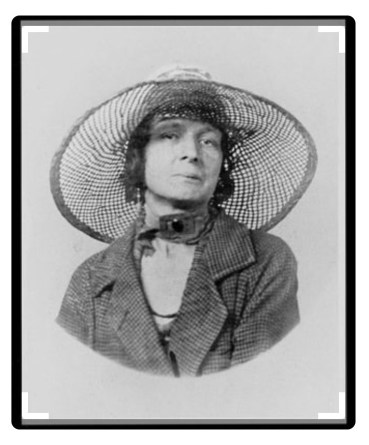
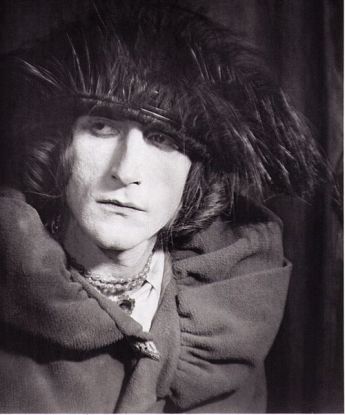
Take a long look at these two photographs. Notice anything?
The one on the top is of Baroness Elsa Freytag-Loringhoven. The one on the bottom is of Rrose Sélavy AKA Marcel Duchamp. Both are attibuted to Man Ray circa 1920-21.
Freytag-Loringhoven admired Duchamp both artistically and perhaps romantically. One of her early performances consisted of her rubbing a newspaper article about the artist’s famous painting Nude Descending a Staircase (1912) over her naked body and then reciting a poem that ended, “Marcel, Marcel, I love you like Hell, Marcel.” While Duchamp did not return her romantic advances, he did return the admiration for her as an artist, saying, “She’s not a futurist. She is the future.” Some historians suggest that the Baroness’s persona and physical appearance inspired Duchamp to adopt his female alter-ego Rrose Selavy. Openly bisexual in the 1920s, Freytag-Loringhoven’s unapologetic sexuality and promiscuity caused much scandal, even among her avant-garde confrères, and sometimes overshadowed the art she created. — from the biography Baroness Elsa by Irene Gammel.
What do you call a day when the shoe drops? Are you still waiting for the other one?
What do you say when you discover a counter story to one you have held for so very long?
There are the days before and the days after a profound revelation. What happens when one gets to the source of a deeply entrenched narrative and find the truth is not as you thought or as you were taught?
This week, my long held beliefs about Marcel Duchamp were shattered. For years I have been fascinated by his alter-ego female persona Rrose Sélavy. That was the first to go… and then that pesky R. Mutt toilet — discussion of which has graced several of our History of posts (here and here and here). That urinal was not a Duchampian instigation but was first identified as “found” by the Baroness.
It’s fraught story of love and intrigue that begs for a revision of art history. What happens when that toilet descends the staircase?



 Back in my studio, from my quick plein-air 9″ x 12″ charcoal sketches, with pastel and pencil I enlarged my drawings to 24″ x 35″. Perhaps it’s my bent towards anthropomorphising their astute qualities but especially now, looking back some 40 years, I see the human figure in my forms.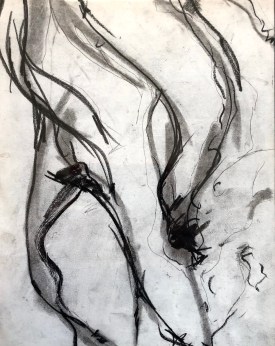




 Now of Now Art