Trees were recently big news, a trillion of them, at the Davos Economic Forum when Greta Thunberg lambasted Trump’s plan to just plant more trees to stave off the effects of global warming. As they swung at each other, their comments swung between outrage and optimism.
Ms. Thunberg: “We are not telling you to offset your emissions by just paying someone else to plant trees in places like Africa, while at the same time forests like the Amazon are being slaughtered at an infinitely higher rate. Planting trees is good of course, but it’s nowhere near enough of what is needed, and it cannot replace real mitigation or rewilding nature.”
Even the New Yorker January 20, 2020 is on the case with trees being the subject of this feature The Past and the Future of the Earth’s Oldest Trees.
Bristlecone pines are famous for attaining a great age. Once the seedling has established itself, it grows slowly, oh so slowly, making the bark tough and resistant to rot, insects, and fungi. The oldest, Methuselah, clocks in at 4,817 years. The trees are dated using a coring device to bore in and extract a very thin sample. Then the rungs are counted to determine the years and to study the markers of extreme weather conditions. Now these trees are serving as enviromental time keepers, as chroniclers of weather and geologic events, confirming evidence of climate change.
Empires rise and empires fall and the foibles of humanity go on and on. These trees have survived catastrophes and they hopefully will survive our latest environmental folly.
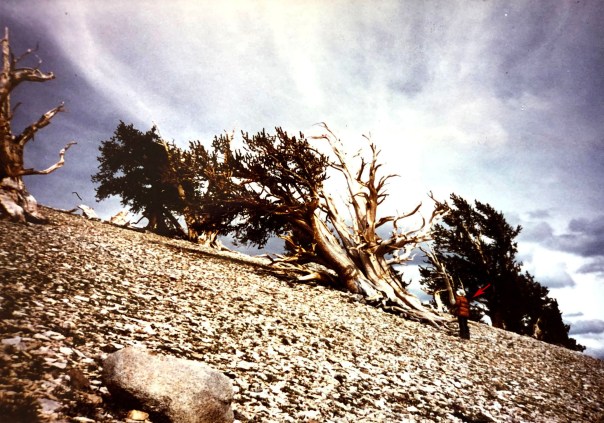
For thousands of years, in the rarefied heights (10,000′) they have endured, standing strong — reaching to the awesome clarity of space and griping tenaciously to barren rocks in a testament to perseverance. Shaped by wind and snow, hardened and polished by the forces of nature, the bristlecone pines twist and dance over time with tenacity.
In 1980 I made the arduous trek to the Ancient Bristlecone Pine Forest in the White Mountains. Since then these awesome life forms have loomed large in my imagination. With sketchbook in hand I am the tiny figure with the orange parka and the white hat, (red arrow pointing).
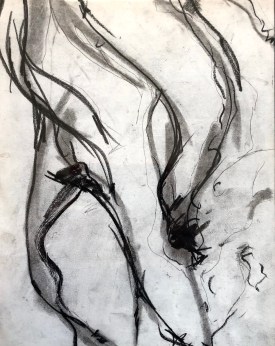
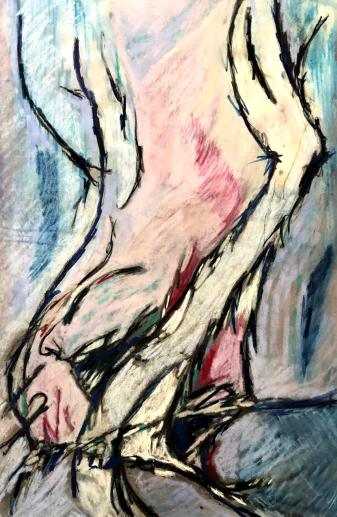
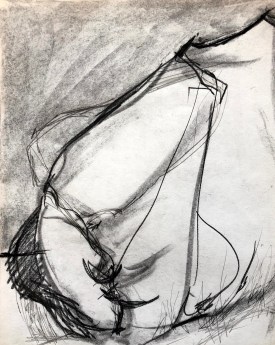
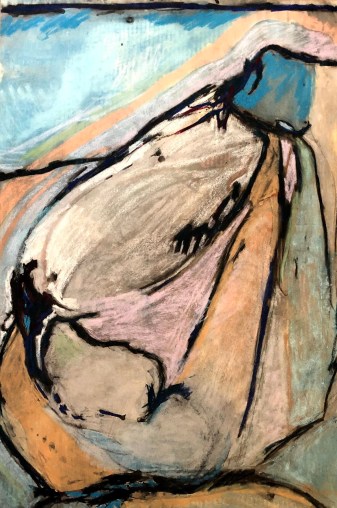
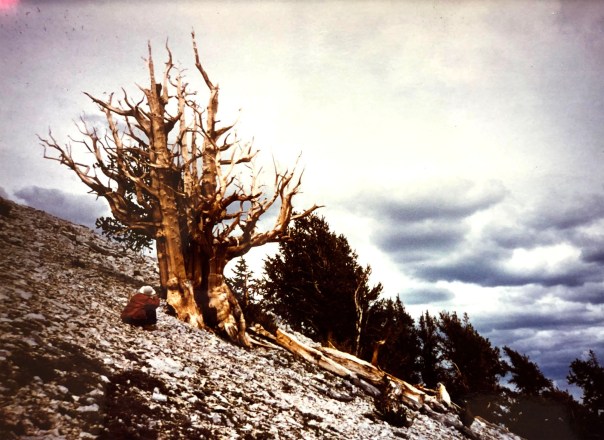 Back in my studio, from my quick plein-air 9″ x 12″ charcoal sketches, with pastel and pencil I enlarged my drawings to 24″ x 35″. Perhaps it’s my bent towards anthropomorphising their astute qualities but especially now, looking back some 40 years, I see the human figure in my forms.
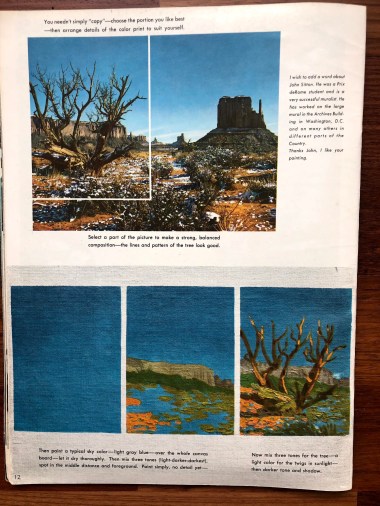
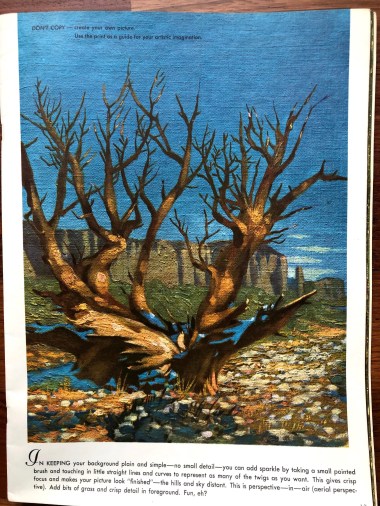
In my teens, trees were a subject. Both of my parents learned the basics of painting from the Walter Foster How-To books. His step-by-step instruction made it easy even for beginners to accomplish a detailed landscape. His lesson on the gnarly branches of the juniper tree in Monument Valley was the source for the painting that hung for years in our family den. Revisiting this now, I can see how my expressive marks, took a cue from WF.
Any discussion of trees must include W.S. Merwin — his poetry and his commitment to planting trees. The Poet Who Planted Trees .

For tenacity, we’ve now been at it as artists for a long long time. For trees, we don’t need trillions, just one or two inspiring examples.
As we draw and paint, a conversation ensues. Our marks on paper, on canvas are our responses to the voices, the tastes, and the touches we experience. By making marks, we create ourselves a tiny bit more – and we can actually see more and feel more, because we have, in that tiny bit, become more.
.
 Now of Now Art